
Nintendo has once again taken aim at Nintendo Switch emulation, with a new wave of DMCA takedown notices resulting in 401 emulator-related repositories being removed from GitHub.
The latest action targeted a number of Switch emulation projects and forks, including repositories connected to Suyu, Skyline, MonoNX and Yuzu-derived projects.
However, there is an important distinction to make: this does not mean Nintendo removed 401 completely separate Switch emulators.
Many of the repositories were forks, mirrors or modified versions of existing projects. In fact, Suyu alone accounted for a huge portion of the total.
Nintendo Targets Suyu, Skyline and More
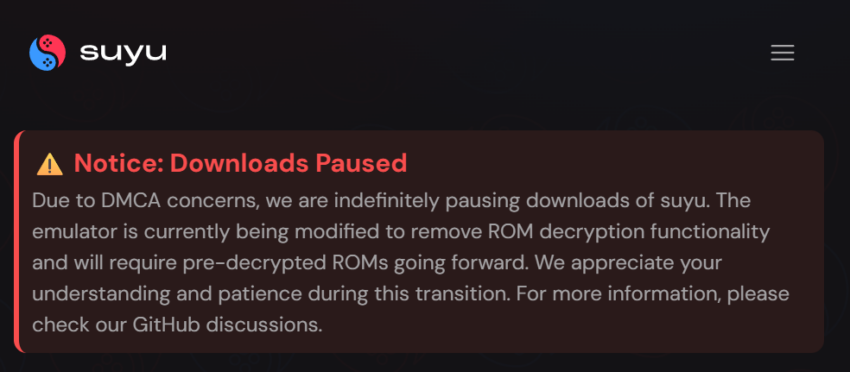
Nintendo submitted multiple DMCA takedown notices to GitHub covering networks of repositories associated with Switch emulation.
The biggest target was Suyu, a Switch emulator project that appeared following the shutdown of Yuzu in 2024.
GitHub processed the takedown across a network containing more than 300 Suyu-related repositories, including forks based on the original project.
Other affected projects included Skyline, an Android-based Nintendo Switch emulator, as well as MonoNX and several Yuzu-derived repositories.
The result was a total of 401 repositories being taken down.
Why Does Nintendo Say Switch Emulators Violate the DMCA?
Nintendo’s argument centres around the way Switch games are protected.
Nintendo Switch software uses encryption and other technological protection measures designed to prevent unauthorised access and copying.
According to Nintendo, Switch emulators rely on proprietary cryptographic keys — commonly referred to as prod.keys — to decrypt game software so it can be run outside Nintendo hardware.
Nintendo argues that this amounts to circumventing its technological protection measures.
In its DMCA notices, Nintendo has repeatedly argued that distributing software designed to perform this circumvention constitutes unlawful trafficking in circumvention technology under the Digital Millennium Copyright Act.
That legal argument has become one of Nintendo’s main weapons in its increasingly aggressive campaign against Switch emulation.
Nintendo Previously Targeted More Than 8,500 Yuzu Repositories
This is far from the first large-scale emulator takedown Nintendo has pursued.
In May 2024, GitHub processed another Nintendo DMCA notice relating to Yuzu, one of the most popular Nintendo Switch emulators at the time.
That action affected an enormous network of 8,535 repositories, including forks, mirrors and projects containing Yuzu code.
The takedowns came shortly after Nintendo took much more dramatic legal action against the people behind Yuzu.
Nintendo’s Lawsuit Against Yuzu
In February 2024, Nintendo filed a lawsuit against Tropic Haze LLC, the company responsible for developing Yuzu.
Nintendo accused the emulator’s developers of facilitating widespread Nintendo Switch piracy and argued that Yuzu was specifically designed to circumvent the technological protections built into Switch games.
One of the most notable examples included in Nintendo’s lawsuit involved The Legend of Zelda: Tears of the Kingdom.
The game officially launched on May 12, 2023, but leaked copies began circulating online before release.
Nintendo claimed that between May 1 and May 10, pirated copies of Tears of the Kingdom were successfully downloaded more than one million times.
Nintendo also claimed that a significant number of download links specifically referenced emulation or Yuzu.
The company used the early piracy of Tears of the Kingdom as a major example of what it described as piracy occurring on a massive scale.
Yuzu Shut Down and Nintendo Received $2.4 Million
The lawsuit moved incredibly quickly.
Only days after Nintendo filed the case, Tropic Haze reached an agreement with Nintendo.
As part of the final judgment, Tropic Haze agreed to permanently stop developing and distributing Yuzu.
Nintendo was also awarded $2.4 million, while Yuzu’s website, software and related assets were shut down or surrendered.
At the time, it looked like Nintendo had dealt a major blow to Switch emulation.
But because Yuzu was open-source software, shutting down the official project did not make its code disappear from the internet.
Copies, forks and successor projects quickly began appearing.
Suyu was one of the most prominent examples.
Nintendo’s Fight Against Switch Emulation Continues
Nintendo has continued pursuing emulator projects ever since.
The company has targeted a long list of Switch emulators and forks, while GitHub has repeatedly removed networks of repositories following Nintendo DMCA complaints.
The latest removal of 401 repositories is another reminder that Nintendo has absolutely no intention of easing up.
Whether the company can ever completely remove Switch emulator code from the internet is another matter entirely.
Once open-source software has been copied, forked and redistributed across thousands of repositories and websites, permanently eliminating it becomes extremely difficult.
But one thing is clear: Nintendo’s fight against Switch emulation is far from over.
What do you think?
Is Nintendo justified in taking such aggressive action against Switch emulator projects, or do you think legitimate emulation is getting caught in the crossfire?
Let us know in the comments of the video and don’t forget to subscribe to us on YouTube!




Comments are closed, but trackbacks and pingbacks are open.